
Chalcedony
Chalcedony is the name for the many kinds of quartz made of microscopic crystals (microcrystalline or cryptocrystalline quartz), rather than large, visible crystals. It is made mainly of fine fibres of quartz with small amounts of a related mineral, moganite. Chalcedony has a waxy lustre, is translucent to opaque, and is porous enough to absorb dye.
Chalcedony at a glance
| Colour | All colours; plain stones often white, grey, blue, lavender; often dyed |
|---|---|
| Hardness (Mohs scale) | 6.5 – 7 |
| Composition | Silicon dioxide (quartz with moganite) |
| Crystal structure | Trigonal; microcrystalline aggregate |
| Lustre | Waxy to vitreous |
| Transparency | Translucent to opaque |
| Where it is found | Brazil, Uruguay, India, Madagascar, Mexico, Namibia, Turkey, Indonesia and USA |
Many popular gemstones are varieties of chalcedony. These include agate (banded), onyx and sardonyx (parallel-banded), carnelian and sard (orange to brown), chrysoprase (apple green, coloured by nickel), bloodstone or heliotrope (dark green with red spots), moss agate and tree agate (with dendritic inclusions), fire agate (with iridescent layers) and chrome chalcedony. Jasper is closely related but contains more impurities and is opaque. Stones sold simply as "chalcedony" are usually translucent, plain-coloured material, especially a soft lavender or sky blue; blue chalcedony comes from Namibia, Turkey, Malawi and Indonesia, among other places.
The name probably comes from Chalcedon, an ancient Greek town in what is now Istanbul. Chalcedony has been used since prehistoric times for tools and since the Bronze Age for beads and seals, and it is one of the stones of the High Priest's breastplate in the Bible.
Because it is porous, chalcedony is very often dyed to produce vivid colours such as bright blue, pink, green, red and black (sold as black onyx). Heating can also change its colour. Chalcedony is found worldwide, with important sources including Brazil, Uruguay, India, Madagascar, Mexico, Namibia, Turkey, Indonesia and the USA.
Caring for chalcedony
Chalcedony is fairly hard (6.5 – 7 on the Mohs scale) and has no cleavage, making it durable for everyday jewellery. Clean it with warm soapy water and a soft brush, then rinse and dry. Avoid harsh chemicals and prolonged heat or sunlight, especially with dyed chalcedony. Ultrasonic and steam cleaning are best avoided. Store separately from harder gems.
Shop chalcedony beads
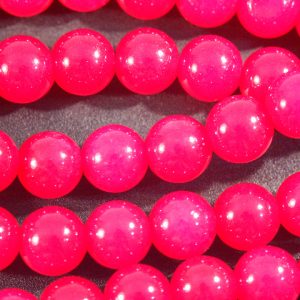
Fuchsia Dyed Jade 10mm Round Beads, Strand
Price range: £6.40 through £25.60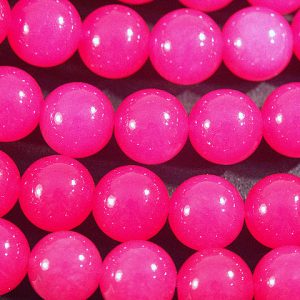
Fuchsia Dyed Jade 12mm Round Beads, Strand
Price range: £6.95 through £27.80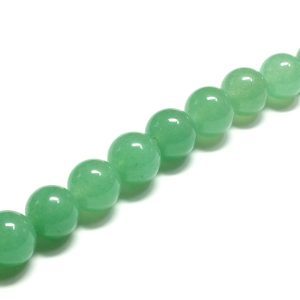
Strand 10mm Dyed Light Green Malay Jade (Dyed Quartz) Beads
Price range: £3.01 through £12.05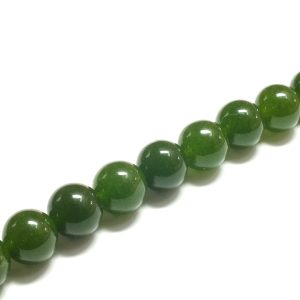
Strand 10mm Dyed Dark Green Malay Jade (Dyed Quartz) Beads
Price range: £3.64 through £14.60In folklore
The beliefs below are traditional folklore, included for interest. They are not scientifically proven, and nothing here is medical advice.
Chalcedony has been carved into seals and amulets since ancient times. In the Middle Ages it was believed to protect against bad dreams and evil spirits, and sailors carried it to protect them from drowning. Chalcedony is one of the foundation stones of the New Jerusalem in the Book of Revelation, and it was said to bring victory in legal disputes. It is associated with the zodiac signs Cancer and Sagittarius.
Chalcedony is traditionally regarded as a nurturing, calming stone that encourages harmony and goodwill. Crystal healing lore holds that it soothes anger and sadness, promotes kindness and generosity, and helps people communicate and listen well. Blue chalcedony is linked to the throat chakra and is often called the "speaker's stone".
Related stones
Agate, onyx, sardonyx, carnelian, sard, chrysoprase, bloodstone, moss agate, fire agate, chrome chalcedony, gem silica (chrysocolla chalcedony) and jasper. Stones that can look similar include moonstone, opal, jade, quartz and glass.
For the technically minded
| Scientific name | SiO2 |
|---|---|
| Density | 2.58 – 2.64 |
| Refractive index | 1.530 – 1.540 |
| Double refraction | Up to 0.004 |
| Cleavage | None |
| Streak | White |
| Fluorescence | Variable; some yellowish-green (SW) |