
Sunstone

Sunstone is a feldspar that shows a sparkling, glittering effect called aventurescence, caused by tiny, flat, reflective inclusions that catch the light. Most sunstone is oligoclase feldspar containing platelets of hematite or goethite, which give a warm orange to red-brown colour and a coppery glitter. Some sunstone is orthoclase or labradorite feldspar.
Sunstone at a glance
| Colour | Orange, red-brown, gold; Oregon: yellow, red, green; glittering |
|---|---|
| Hardness (Mohs scale) | 6 – 6.5 |
| Composition | Sodium calcium aluminium silicate (feldspar) with metal inclusions |
| Crystal structure | Triclinic |
| Lustre | Vitreous |
| Transparency | Transparent to opaque |
| Where it is found | India, Norway, Tanzania, Madagascar, USA (Oregon), Russia, Canada and Australia |
Oregon sunstone, from the state of Oregon in the USA, is a transparent labradorite containing copper inclusions. It occurs in a range of colours, including pale yellow, orange, red, green and blue, sometimes in a single stone, and is Oregon's state gemstone. Other important sources include India, Norway, Tanzania, Madagascar, Russia, Canada and Australia.
Sunstone is cut as faceted stones, cabochons and beads. Some sunstone sold as "andesine" in the early 2000s was later found to have been coloured artificially by copper diffusion. Goldstone, a man-made glass containing copper crystals, is often sold as or confused with sunstone; it has much more uniform, evenly spread sparkles than natural sunstone. Sunstone can also be confused with red aventurine, which is quartz rather than feldspar.
Caring for sunstone
Sunstone (6 – 6.5 on the Mohs scale) has perfect cleavage in two directions and can chip or split if knocked. Clean it with warm soapy water and a soft brush, then dry. Avoid ultrasonic and steam cleaners, harsh chemicals, high heat and sudden temperature changes. Store separately from harder gems in a soft pouch.
Shop sunstone beads
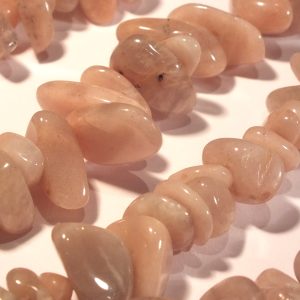
Strand Approx 39cm Sunstone Chip Beads 10x5mm
Price range: £5.11 through £35.80In folklore
The beliefs below are traditional folklore, included for interest. They are not scientifically proven, and nothing here is medical advice.
Sunstone has long been associated with the sun and its life-giving energy. Native American legends tell that Oregon sunstone was coloured by the blood of a wounded warrior, which carried his spirit into the stone. Norse sagas describe a "sunstone" used by Vikings to find the sun on cloudy days, although this was probably a crystal of Iceland spar rather than feldspar sunstone. Sunstone is associated with the zodiac signs Leo and Libra.
Sunstone is traditionally regarded as a stone of joy, warmth and personal power. Crystal healing lore holds that it lifts the spirits, encourages optimism and independence, and helps dispel fear and self-doubt. It is also said to bring good luck and success. It is linked to the sacral and solar plexus chakras.
Related stones
Oregon sunstone, oligoclase, labradorite, moonstone, rainbow moonstone, amazonite and andesine. Stones that can look similar include goldstone, red aventurine, carnelian, fire opal and orange glass.
For the technically minded
| Scientific name | (Na,Ca)AlSi3O8 (variable) |
|---|---|
| Density | 2.62 – 2.72 |
| Refractive index | 1.525 – 1.580 |
| Double refraction | 0.007 – 0.010 |
| Cleavage | Perfect in two directions |
| Streak | White |
| Fluorescence | Generally inert |