
Mookaite

Mookaite, also called mookaite jasper, is a colourful rock from Western Australia. It is a type of radiolarite or chert: a sedimentary rock formed from the silica skeletons of microscopic marine plankton (radiolarians) that settled on the floor of a shallow inland sea during the Cretaceous period, roughly 100 million years ago. Over time this silica hardened into rock, and iron-rich fluids gave it its bold colours.
Mookaite at a glance
| Colour | Red, maroon, mustard yellow, ochre, cream, pink, purple; mixed |
|---|---|
| Hardness (Mohs scale) | 6.5 – 7 |
| Composition | Silicon dioxide (chert, jasper, chalcedony) with iron oxides |
| Crystal structure | Trigonal; microcrystalline aggregate |
| Lustre | Vitreous to waxy |
| Transparency | Opaque |
| Where it is found | Australia (Kennedy Ranges, Western Australia) |
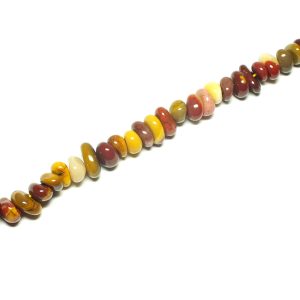
Mookaite comes almost exclusively from the Kennedy Ranges area near Gascoyne Junction in Western Australia, and takes its name from Mooka Creek and the nearby Mooka cattle station. Its colours include deep red, maroon, mustard yellow, ochre, cream, white, pink and purple, often mixed together in swirls, patches and bands. Deeper reds contain more iron, while creams and whites are purer silica.
Although widely sold as jasper, mookaite can contain jasper, chert, chalcedony and opaline silica. It has been used by Aboriginal Australians for thousands of years for tools, as it breaks in a controlled way. Today it is popular for beads, cabochons, carvings and tumbled stones. It is generally untreated, though some material may be dyed or stabilised.
Caring for mookaite
Mookaite is fairly hard (6.5 – 7 on the Mohs scale) and durable, making it suitable for everyday jewellery. Clean it with warm soapy water and a soft brush, then rinse and dry. Avoid harsh chemicals, ultrasonic and steam cleaners and high heat. Store it separately from harder gems to avoid scratches.
Shop mookaite beads
In folklore
The beliefs below are traditional folklore, included for interest. They are not scientifically proven, and nothing here is medical advice.
The name mookaite is said to come from a local Aboriginal word meaning "running waters", referring to the creek near the deposit, and Aboriginal Australians have long valued the stone. In modern tradition it is known as a "mother earth stone" and a protective stone for travellers and adventurers. Mookaite is associated with the zodiac signs Virgo and Scorpio.
Mookaite is traditionally regarded as a grounding yet energising stone. Crystal healing lore holds that it balances the desire for adventure with the need for calm, encourages flexibility and decision-making, and supports the immune system and physical vitality. It is also said to help the wearer stay in the present moment. It is linked to the root and sacral chakras.
Related stones
Jasper, chert, radiolarite, chalcedony, agate and picture jasper. Stones that can look similar include red jasper, picture jasper, brecciated jasper, Kambaba jasper and dyed jasper.
For the technically minded
| Scientific name | SiO2 (with iron oxides) |
|---|---|
| Density | 2.50 – 2.90 |
| Refractive index | 1.54 – 1.55 |
| Double refraction | Not detectable |
| Cleavage | None |
| Streak | White to reddish |
| Fluorescence | Generally inert |