
Lava Rock

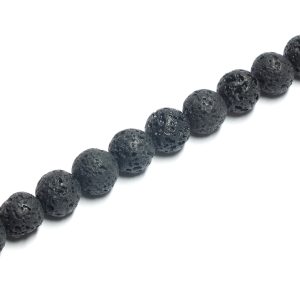
Lava rock (or lava stone) used for beads is basalt, a dark volcanic rock formed when molten lava cools and hardens at the Earth's surface. Basalt is made of fine grains of minerals such as plagioclase feldspar, pyroxene and olivine, sometimes with volcanic glass. As the lava cools, gas escapes and leaves countless small holes (vesicles) in the rock, which give lava beads their rough, pitted texture and make them surprisingly light for their size.
Lava Rock at a glance
| Colour | Black, dark grey, brown; widely dyed in bright colours |
|---|---|
| Hardness (Mohs scale) | 5 – 6 |
| Composition | Basalt: plagioclase, pyroxene, olivine and volcanic glass |
| Crystal structure | Rock (aggregate); vesicular |
| Lustre | Dull, matte |
| Transparency | Opaque |
| Where it is found | Indonesia, China, Iceland, Italy, Mexico and USA (Hawaii) |
Natural lava beads are matte black to dark grey, and sometimes brown or reddish. Because the stone is porous, it is easily dyed, and lava beads are widely sold in bright colours such as blue, green, red, purple, yellow and white. Some beads are also coated or plated with metallic finishes.
The porous surface absorbs liquids, which has made lava beads very popular for aromatherapy jewellery: a drop or two of essential oil applied to the beads is slowly released over several hours. Lava beads are also popular in men's bracelets and with natural, earthy designs.
Lava rock is found wherever there has been volcanic activity, and most beads are made in Indonesia and China. Heavy, smooth beads sold as "lava" may be imitations made of other materials.
Caring for lava rock
Lava rock (about 5 – 6 on the Mohs scale) is fairly tough but porous and can crumble at edges or wear other beads. Wipe it with a dry or slightly damp cloth. Avoid soaking, ultrasonic and steam cleaners, and harsh chemicals, as these can remove dye. If using essential oils, apply them only to the lava beads and allow them to dry before wearing, as oils can damage other beads, cord and metals. Store separately.
Shop lava rock beads
In folklore
The beliefs below are traditional folklore, included for interest. They are not scientifically proven, and nothing here is medical advice.
Volcanic rock has long been associated with fire, creation and rebirth, as it is formed from the molten heart of the Earth. In Hawaiian tradition, lava is linked with Pele, the goddess of volcanoes and fire, and some believe it is unlucky to take lava rock from Hawaii. Lava stone is associated with the zodiac signs Aries, Leo and Sagittarius.
Lava rock is traditionally regarded as a grounding and strengthening stone, connected with the energy of the Earth. Crystal healing lore holds that it brings stability and calm in times of change, gives strength and courage, and helps release anger. It is linked to the root chakra.
Related stones
Basalt, obsidian (volcanic glass), pumice, scoria and Apache tears. Lava beads are often combined with tiger's eye, turquoise, onyx and wooden beads in bracelets.
For the technically minded
| Scientific name | Rock (basalt) |
|---|---|
| Density | 2.0 – 3.0 |
| Cleavage | None |
| Streak | Grey |
| Fluorescence | None |