
Pyrite
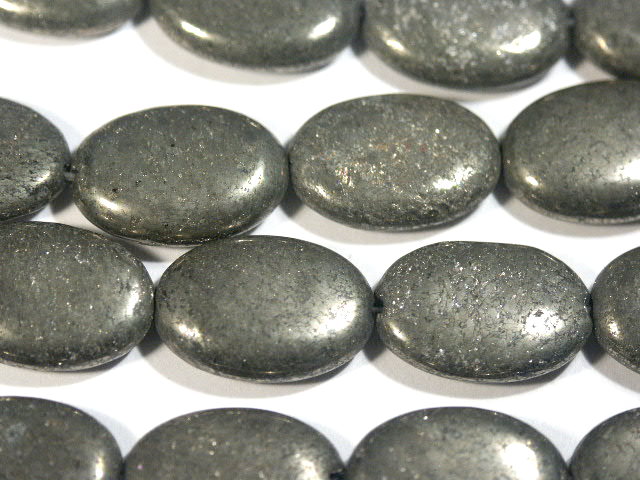
Pyrite is an iron sulphide mineral with a bright, brassy yellow metallic lustre. Its resemblance to gold has earned it the nickname "fool's gold", although it is much harder and more brittle than gold and leaves a greenish-black streak rather than a gold one. Pyrite often forms striking natural cubes, as well as twelve-sided crystals (pyritohedra), octahedra and sparkling clusters.
Pyrite at a glance
| Colour | Pale brass yellow; tarnishes darker or iridescent |
|---|---|
| Hardness (Mohs scale) | 6 – 6.5 |
| Composition | Iron sulphide |
| Crystal structure | Cubic; cubes, pyritohedra, octahedra |
| Lustre | Metallic |
| Transparency | Opaque |
| Where it is found | Spain, Peru, Italy, China, Russia, Mexico and USA |
The name comes from the Greek "pyr", meaning fire, because pyrite gives off sparks when struck against steel or flint. It was used to start fires in prehistoric times; Otzi, the 5,000-year-old "Iceman" found in the Alps, carried pyrite in his fire-making kit. In the 16th and 17th centuries it was used to ignite wheel-lock firearms. Pyrite is one of the most common sulphide minerals and is found worldwide; Spain, particularly the area around Navajun, is famous for perfect cubic crystals, and Peru is known for large clusters.
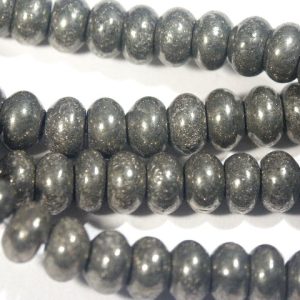
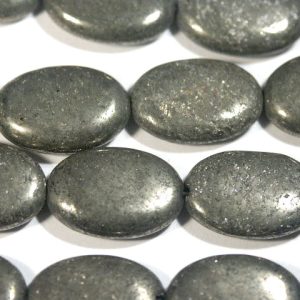
In jewellery, small faceted pieces of pyrite set in silver are traditionally called "marcasite", and were very popular in Victorian and Art Deco jewellery. True marcasite is a different, less stable mineral with the same chemistry. Pyrite is also cut into beads, often faceted or in natural cube shapes, and it occurs as gold flecks in lapis lazuli.
Pyrite can slowly tarnish and, in damp conditions, may decompose ("pyrite decay"), producing sulphuric acid and a white powder. Keeping it dry helps prevent this.
Caring for pyrite
Pyrite (6 – 6.5 on the Mohs scale) is hard but brittle, and can chip or break if dropped. Keep it dry: wipe it with a soft, dry cloth and never soak it or use water-based or ultrasonic cleaning, as moisture can cause tarnish and decay. Avoid acids, perfume and cleaning products. Store it in a dry place, separately from other gems, as it can scratch softer stones.
Shop pyrite beads
In folklore
The beliefs below are traditional folklore, included for interest. They are not scientifically proven, and nothing here is medical advice.
Pyrite's spark-making properties made it important to early peoples, and it has long been associated with fire and the sun. The Incas and other ancient American peoples polished large slabs of pyrite into mirrors, which may have been used for divination. In some traditions, pyrite cubes are kept in homes and businesses to attract money. Pyrite is associated with the zodiac sign Leo.
Pyrite is traditionally regarded as a stone of abundance, protection and confidence. Crystal healing lore holds that it attracts wealth and success, boosts willpower and motivation, and shields the wearer from negative energy. It is also said to sharpen the mind and support leadership. It is linked to the solar plexus chakra.
Related stones
Marcasite, chalcopyrite, hematite, magnetite and gold. Pyrite is commonly found in lapis lazuli and with quartz, calcite and fluorite. Stones and materials that can look similar include gold, marcasite, chalcopyrite, hematite with gold coating and gold-plated metal beads.
For the technically minded
| Scientific name | FeS2 |
|---|---|
| Density | 4.95 – 5.10 |
| Cleavage | Indistinct |
| Streak | Greenish-black to brownish-black |
| Fluorescence | None |