
Apatite

Apatite is a group of calcium phosphate minerals; the form most often used as a gemstone is fluorapatite. Apatite is 5 on the Mohs scale, the reference mineral for that level of hardness, and it occurs in many colours, including blue, green, yellow, violet, pink, brown and colourless. The most popular colour in jewellery is a vivid neon blue to blue-green, much of which comes from Madagascar and can resemble the much rarer Paraiba tourmaline.
Apatite at a glance
| Colour | Blue, blue-green, green, yellow, violet, pink, brown, colourless |
|---|---|
| Hardness (Mohs scale) | 5 |
| Composition | Calcium phosphate with fluorine, chlorine or hydroxyl |
| Crystal structure | Hexagonal; hexagonal prisms |
| Lustre | Vitreous to sub-resinous |
| Transparency | Transparent to opaque |
| Where it is found | Madagascar, Brazil, Mexico, Myanmar, Sri Lanka, Canada, Russia, India and Morocco |
The name comes from the Greek "apatao", meaning to deceive, because apatite is easily mistaken for other minerals such as beryl, tourmaline, peridot and topaz. Apatite is also the mineral that makes up much of the teeth and bones of animals, including humans, and phosphate rock containing apatite is an important source of fertiliser.
Gem apatite is found in Madagascar, Brazil, Mexico, Myanmar, Sri Lanka, Canada, Russia, India and Morocco. Mexico is known for yellow "asparagus stone", and some apatite contains fine needles that produce a cat's-eye effect when cut as a cabochon.
Transparent stones are faceted, while more included and opaque material is used for beads, cabochons and tumbled stones. Apatite may be heat-treated to improve its colour. It is relatively soft for a gemstone and needs careful handling.
Caring for apatite
Apatite is relatively soft (5 on the Mohs scale) and brittle, and can scratch or chip easily. It is best for earrings and pendants rather than rings and bracelets. Clean it gently with lukewarm soapy water and a soft cloth. Avoid ultrasonic and steam cleaners, acids, high heat and sudden temperature changes. Store it separately from harder gems in a soft pouch.
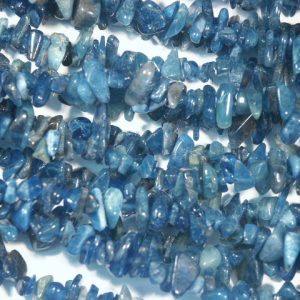
Shop apatite beads
In folklore
The beliefs below are traditional folklore, included for interest. They are not scientifically proven, and nothing here is medical advice.
Apatite was only named as a mineral in 1786, so it has little ancient folklore of its own, though it was likely worn unknowingly in the past in place of other gems it resembles. In modern tradition it is associated with learning, manifestation and achieving goals. Apatite is associated with the zodiac signs Gemini and Libra.
Apatite is traditionally regarded as a stone of motivation, inspiration and focus. Crystal healing lore holds that it encourages ambition and drive, enhances creativity and communication, and helps the wearer stay focused on goals. Blue apatite is linked to the throat and third eye chakras, and it is often associated with healthy bones and teeth because of its natural link to them.
Related stones
Fluorapatite, hydroxylapatite, chlorapatite and phosphorite. Stones that can look similar include Paraiba tourmaline, aquamarine, blue topaz, peridot, beryl, tourmaline, fluorite and glass.
For the technically minded
| Scientific name | Ca5(PO4)3(F,Cl,OH) |
|---|---|
| Density | 3.16 – 3.23 |
| Refractive index | 1.634 – 1.638 |
| Double refraction | 0.002 – 0.008 |
| Cleavage | Poor |
| Streak | White |
| Fluorescence | Variable: yellow, blue, pink or green by colour |